Whilst in the planning stage for the project we had to decide what our core and wider audience would be. We researched audiences and what type of audiences liked what, such as teenage girls liking rom-coms and younger children liking cartoons. We looked into also how age and gender can affect what an audience chooses to watch. For example the elderly are most likely to watch old classic films from their time, and less likely to watch horror films as when they were younger there weren’t many horror films around. Youths will tend to watch big blockbusters that are very modern with many special effects such as Transformers or fun family films like Night at the Museum. Young adults to middle aged people might prefer dramas with an enigma or disruptions which enable you to think. Gender also effects what an audience might choose. Girls may prefer romantic-comedies while it is shown that genres where as boys may be more inclined to watch action films. People’s hobbies can also affect the films they watch, like art students may be more inclined to watch independent quirky films, but other students may prefer mainstream films.
Age- We decided that because our film is quite serious, with adult themes we made our film certificate 15. Our core audience is mostly students ages 18-25
Our secondary, wider audience is people ages 16-40 as we believe anyone who enjoys the horror/thriller genre will enjoy our film. Younger children would not enjoy our film as it has themes of death and rape; this is why elderly people may not like it either.
Gender- Our film is not gender specific in its audience
Nationality- Our film will be most enjoyed by British as they can relate to the film.
Lifestyle- The people who will want to watch our film are well educated, and will enjoy the complexities and enigmas of our plots. This is why we are targeting students as our audience. They are young and insightful and will enjoy our quirky camera style, as well as the plot about the internet. Their tastes in media will be similar to that of our film-films that keep you on the edge of your seat. We appeal to the audience expectations; they expect to be scared, to jump and to have to try and piece together the storyline.
Wednesday, January 21, 2009

Q3) What kind of media institution might distribute your product and why?
Our production company ‘Hand Print Productions’ make low budget thrillers to target a student audience interested in horror and thriller.
The type of media institution distributing your media product depends largely on what type of film you are creating. If you have created a large Hollywood block buster that you want to be seen worldwide, you would show it in the main cinemas like ‘Odeon and Vue’ in the UK to appeal to the widest audience possible to gross a greater profit. However if you had created an independent film, it is limited in where you can show it due to budget and sometimes due to the content of the film. It would usually be shown in small independent cinemas, old cinemas or arty places and at exhibitions, or special independent film screenings at cinemas such as the Rio, or The Phoenix in North London. Often you can also watch them via the internet. If our film was made as a low-budget film (which it was) it would be shown at film festivals, such as the largest one, in Manchester, or on the Independent Film Channel. Most student films are put online and can gain a large audience through the web. For a student film such as ours I believe this would be the best way to target a wider audience.
Although ours is only a student film, in the real media world if our film was made without being on a student budget, I believe ours would be played in the main cinemas in bigger towns, as well as a selective few smaller cinemas for limited time in smaller towns. This is because I believe of piece has quiet a significant message about using the internet, and about how crucial the internet is in our lives and yet it is so potentially dangerous. We are therefore raising awareness through our film, which is why the film should be shown nationwide. By showing it in the main cinemas it would bring in a wider audience and gross more.
Film4 (a well known film channel/distributer/production company), in 2007, began sponsoring an annual ‘FrightFest’ which started in 2000. It is a 4 day film festival that has premiered such films like ‘Scary Movie 1 & 2’, ‘Donnie Darko’ and ‘Jeepers Creepers’. It also has sponsors such as Channel 5 and Horror Channel. In 2005 the ‘FrightFest’ moved to the Odeon Cinema in the West End giving it a wider audience appeal. They also hold events called ‘Fright Fest Presents’ at universities such as Cambridge, Brighton and Glasgow; which targets our primary audience perfectly as well as distributing our audience to a large audience at one time. Here's the website-http://www.frightfest.co.uk/
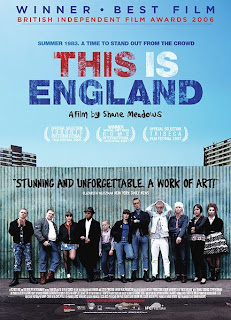
Film4 are a film producing company who have produced award winning British films such as ‘This is England’ (Shane Meadows,2006). I believe Film4 would commission to distribute our film because it is a British film that portrays an important message and will be popular among a young audience.
The type of media institution distributing your media product depends largely on what type of film you are creating. If you have created a large Hollywood block buster that you want to be seen worldwide, you would show it in the main cinemas like ‘Odeon and Vue’ in the UK to appeal to the widest audience possible to gross a greater profit. However if you had created an independent film, it is limited in where you can show it due to budget and sometimes due to the content of the film. It would usually be shown in small independent cinemas, old cinemas or arty places and at exhibitions, or special independent film screenings at cinemas such as the Rio, or The Phoenix in North London. Often you can also watch them via the internet. If our film was made as a low-budget film (which it was) it would be shown at film festivals, such as the largest one, in Manchester, or on the Independent Film Channel. Most student films are put online and can gain a large audience through the web. For a student film such as ours I believe this would be the best way to target a wider audience.
Although ours is only a student film, in the real media world if our film was made without being on a student budget, I believe ours would be played in the main cinemas in bigger towns, as well as a selective few smaller cinemas for limited time in smaller towns. This is because I believe of piece has quiet a significant message about using the internet, and about how crucial the internet is in our lives and yet it is so potentially dangerous. We are therefore raising awareness through our film, which is why the film should be shown nationwide. By showing it in the main cinemas it would bring in a wider audience and gross more.
Film4 (a well known film channel/distributer/production company), in 2007, began sponsoring an annual ‘FrightFest’ which started in 2000. It is a 4 day film festival that has premiered such films like ‘Scary Movie 1 & 2’, ‘Donnie Darko’ and ‘Jeepers Creepers’. It also has sponsors such as Channel 5 and Horror Channel. In 2005 the ‘FrightFest’ moved to the Odeon Cinema in the West End giving it a wider audience appeal. They also hold events called ‘Fright Fest Presents’ at universities such as Cambridge, Brighton and Glasgow; which targets our primary audience perfectly as well as distributing our audience to a large audience at one time. Here's the website-http://www.frightfest.co.uk/

Film4 are a film producing company who have produced award winning British films such as ‘This is England’ (Shane Meadows,2006). I believe Film4 would commission to distribute our film because it is a British film that portrays an important message and will be popular among a young audience.
Q2) How does your media product represent partucular social groups?
We chose to stick to the character conventions in horror/thrillers in that we had a tall, dark guy with a beard who looked very menacing as the killer. His beard and scruffy attire showed he was rough and not clean cut and shows he is hasn’t shaven for a while, because he is busy finding victims. He was in casual, dirty clothes, which showed that he was working class but was also in an overcoat which implied where he lived was cold. His house was a dingy and horrible place also showing his class. It had peeling wall paper and not much furniture to anchor his status, the only real possession he had was a computer, which put forth his determination as the killer more. We had him drinking whisky to show that he was potentially unstable. If we would have shown him to be drinking orange juice, for example, it would have put across a friendlier persona. If you look at other murderers such as Christian Bale’s character in American Psycho (Mary Harron, 2000) , who is very clean shaven and smartly dressed, which anchors that he is smarter, and upper class there is a direct comparison with our main killer in regards to status and wealth.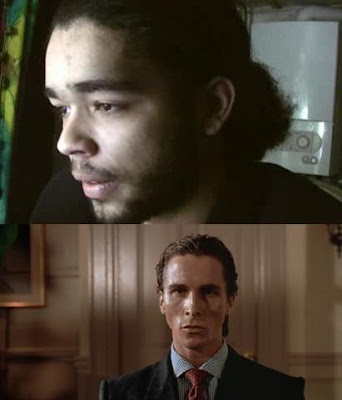 The other murderer was also tall and dressed all in black to look menacing. He is wearing a beanie which fits in with the more ‘classic’ thug/murderer appearance. He was putting knifes and other equipment into a briefcase, showing he is the more violent one and that the one on the computer is more charming.
We used a young girl who looked innocent and lived in a fairly middle class house. She looks innocent by the makeup and clothes she is wearing. Her makeup is minimal, not vulgar or garish, and her clothes are not revealing, she is wearing a knitted top (in pink) and jeans. We can see she is in a middle class house because she has a mobile phone on her bed which also has lots of pillows and looks quite lush. She had her own laptop showing she must be fairly affluent. She had a pink room showing she is girly.
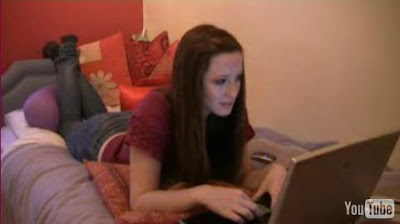
When thinking about how to represent age when had to think about the actors ages. Since our audience is young adults ages between 18-25, we decided to use actors in that age range. Emma’s character would not have worked if she were older, because to seem more helpless she had to be younger.
We were also representing certain states of mind in our film. Obviously our film has a theme of suicide which needs to be approached delicately as it is a very serious matter. Films that have done this well include ‘The Virgin Suicides’ (Sofia Coppola, 1999). The suicidal girls are exploited in our film, due to their vulnerable state. Another state of mind we represent is mental illness. Perhaps not overtly apparent, but clearly the murderer has some mental issues to be murdering young girls. The way we represented this was by making the murderer seem clever and cunning, and yet sick and twisted, which are shown by his facial expressions and lines such as “yeah that comes later darling”.
The other murderer was also tall and dressed all in black to look menacing. He is wearing a beanie which fits in with the more ‘classic’ thug/murderer appearance. He was putting knifes and other equipment into a briefcase, showing he is the more violent one and that the one on the computer is more charming.We used a young girl who looked innocent and lived in a fairly middle class house. She looks innocent by the makeup and clothes she is wearing. Her makeup is minimal, not vulgar or garish, and her clothes are not revealing, she is wearing a knitted top (in pink) and jeans. We can see she is in a middle class house because she has a mobile phone on her bed which also has lots of pillows and looks quite lush. She had her own laptop showing she must be fairly affluent. She had a pink room showing she is girly.
When thinking about how to represent age when had to think about the actors ages. Since our audience is young adults ages between 18-25, we decided to use actors in that age range. Emma’s character would not have worked if she were older, because to seem more helpless she had to be younger.
We were also representing certain states of mind in our film. Obviously our film has a theme of suicide which needs to be approached delicately as it is a very serious matter. Films that have done this well include ‘The Virgin Suicides’ (Sofia Coppola, 1999). The suicidal girls are exploited in our film, due to their vulnerable state. Another state of mind we represent is mental illness. Perhaps not overtly apparent, but clearly the murderer has some mental issues to be murdering young girls. The way we represented this was by making the murderer seem clever and cunning, and yet sick and twisted, which are shown by his facial expressions and lines such as “yeah that comes later darling”.
Q1) In what ways does your media product use, develop or challenge forms and conventions of real media products?
When starting to look at different film genres in preparation for starting our group piece, we looked at different film genres and the conventions of each of those genres. For example rom-com would be very high key (lighting) and would usually had younger attractive people falling in love, with a struggle s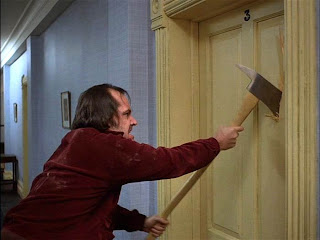 eparating them. Then there was drama; using fast paced editing and lots of action to keep the audience enticed. Then we began to look at horror and thriller and as we did this we focussed deeper and deeper in on it, realising this is probably what we would want to choose for our own genre. And we did. The horror/thriller crossover share many common conventions such as a dark environment (often) with a main murderer, and a main victim (or possible victim). Some of the common themes of horror are death, victims, as well as the conventions of the production such as ominous music, and editing or creating a story which itself creates and enigma for the audience: leaving them guessing. Two examples of this are Hitchcock’s ‘Psycho’ (1960) as well as ‘The Shining’ (Kubrick, 1980) as well as many others. Both films holdback information until the end so the audience are more intrigued and, ultimately, more scared. We generally fit to these conventions of the horror thriller genre by having the classic characters of a ‘victim girl’ and a ‘nasty
 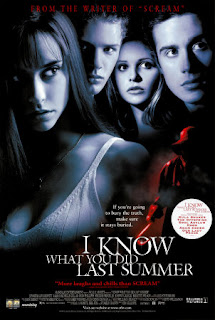 murderer’, as well as using enigmas, by not showing the murderers face until the third thing he says, and having him sign in at the very beginning as ‘Julie’ making audiences believe him to be a woman. We used iconography similar to that of other horror films. These included the location; a dirty cellar and the lighting; low key and shadowy. Another way we represented the genre of a horror/thriller is that we used the theme of stalking, which has been used is film such as ‘I Know What You Did Last Summer’ (Gillespie, 1997). We also used chilling music such as an ominous drone. In our audience feedback it showed that they all thought it was horror/thriller, so it shows that sticking to the conventions works well.
However to be more creative we didn’t stick rigidly to conventions, for example, we used a modern but still twisted storyline, involving the internet, and we also had two murderers which is uncommon in most horror films. We also used a modern piece of music which sounded like a dial-up internet connection to continue our particular theme. We stuck to most of the old forms and conventions of horror with modern twists to it, such as its modern context of meeting people over the internet. We didn’t choose to stick to Todorov’s classic narrative pattern of staring with an equilibrium, with a disruption that eventually gets resolved, because we felt it made more of an impact on the audience to start with disruption.
We also had to look at the conventions of an opening sequence in order to create a film that was accurate in content and in its production
Conventions include:
 eparating them. Then there was drama; using fast paced editing and lots of action to keep the audience enticed. Then we began to look at horror and thriller and as we did this we focussed deeper and deeper in on it, realising this is probably what we would want to choose for our own genre. And we did. The horror/thriller crossover share many common conventions such as a dark environment (often) with a main murderer, and a main victim (or possible victim). Some of the common themes of horror are death, victims, as well as the conventions of the production such as ominous music, and editing or creating a story which itself creates and enigma for the audience: leaving them guessing. Two examples of this are Hitchcock’s ‘Psycho’ (1960) as well as ‘The Shining’ (Kubrick, 1980) as well as many others. Both films holdback information until the end so the audience are more intrigued and, ultimately, more scared. We generally fit to these conventions of the horror thriller genre by having the classic characters of a ‘victim girl’ and a ‘nasty
  murderer’, as well as using enigmas, by not showing the murderers face until the third thing he says, and having him sign in at the very beginning as ‘Julie’ making audiences believe him to be a woman. We used iconography similar to that of other horror films. These included the location; a dirty cellar and the lighting; low key and shadowy. Another way we represented the genre of a horror/thriller is that we used the theme of stalking, which has been used is film such as ‘I Know What You Did Last Summer’ (Gillespie, 1997). We also used chilling music such as an ominous drone. In our audience feedback it showed that they all thought it was horror/thriller, so it shows that sticking to the conventions works well.
However to be more creative we didn’t stick rigidly to conventions, for example, we used a modern but still twisted storyline, involving the internet, and we also had two murderers which is uncommon in most horror films. We also used a modern piece of music which sounded like a dial-up internet connection to continue our particular theme. We stuck to most of the old forms and conventions of horror with modern twists to it, such as its modern context of meeting people over the internet. We didn’t choose to stick to Todorov’s classic narrative pattern of staring with an equilibrium, with a disruption that eventually gets resolved, because we felt it made more of an impact on the audience to start with disruption.
We also had to look at the conventions of an opening sequence in order to create a film that was accurate in content and in its production
Conventions include:
- Introduction to key characters (Elle in Legally Blonde, Luketic 2001)
- Titles throughout
- Music (Shining)
- Info on what is to come (Magdalene Sisters, Peter Mullen 2004)
- Main themes of the film (killers obsessive record keeping in Seven, Fincher 1995)
- Visual references to the title (pumpkins in Halloween, Carpernter 1978)
- Sense of danger from the offset-only for horror (Seven starts with a dead body)
- Symbolic/iconic images
We stuck to all these conventions I believe as we introduced our murderers (the girl was merely the first victim), we had titles throughout and music, introduced the main theme of the internet and gave an insight into what was to come. We have used many narra tive techniques in our sequence such as editing it in real time, using cross-cutting, and a small ellipsis between bits in the conversation. Some of our action and enigmas codes include our montage sequence at the end, and the enigma is when you can hear the printer sound but are unsure as to who is printing it. We used the classic characters roles from horror films such as the victim, insignificant to the overall plot but just one to add to the body count. In our film she is a girl like most horror films including ‘Scream’ (Craven 1996). The overall style of our piece is very eerie, with close-up camera work to show the expressions of both murderer and victims face, be it scared or smug. Our sequence has continuity such as match-on-action and shot reverse shot, however breaks this by having a montage at the end.
Wednesday, January 14, 2009
Test Screen
We had the test screen of our final piece today and it went really well
we got lots of positive feedback which was good but also people suggested things to change.
we got lots of positive feedback which was good but also people suggested things to change.
- turn down treble on master shot of me
- cut music down at end-too distracting
- quiet down sound of keys
- needs a change of music as montage starts-change of music for change of pace-also too distracting..
- drone too loud
- printer quieter
All of these are easily sorted out and we will change them tomorrow. After that we will be done!!
Tuesday, January 6, 2009
Sorry it's been so long...
Haven't been on here in a while-been VERY busy with the group
I plan on filling you in on what has been happening during our production
Sorry that it's taken me this long...but i'm back
x
I plan on filling you in on what has been happening during our production
Sorry that it's taken me this long...but i'm back
x
Saturday, December 20, 2008
Subscribe to:
Posts (Atom)